03 - The evidence
Screenshots, in order
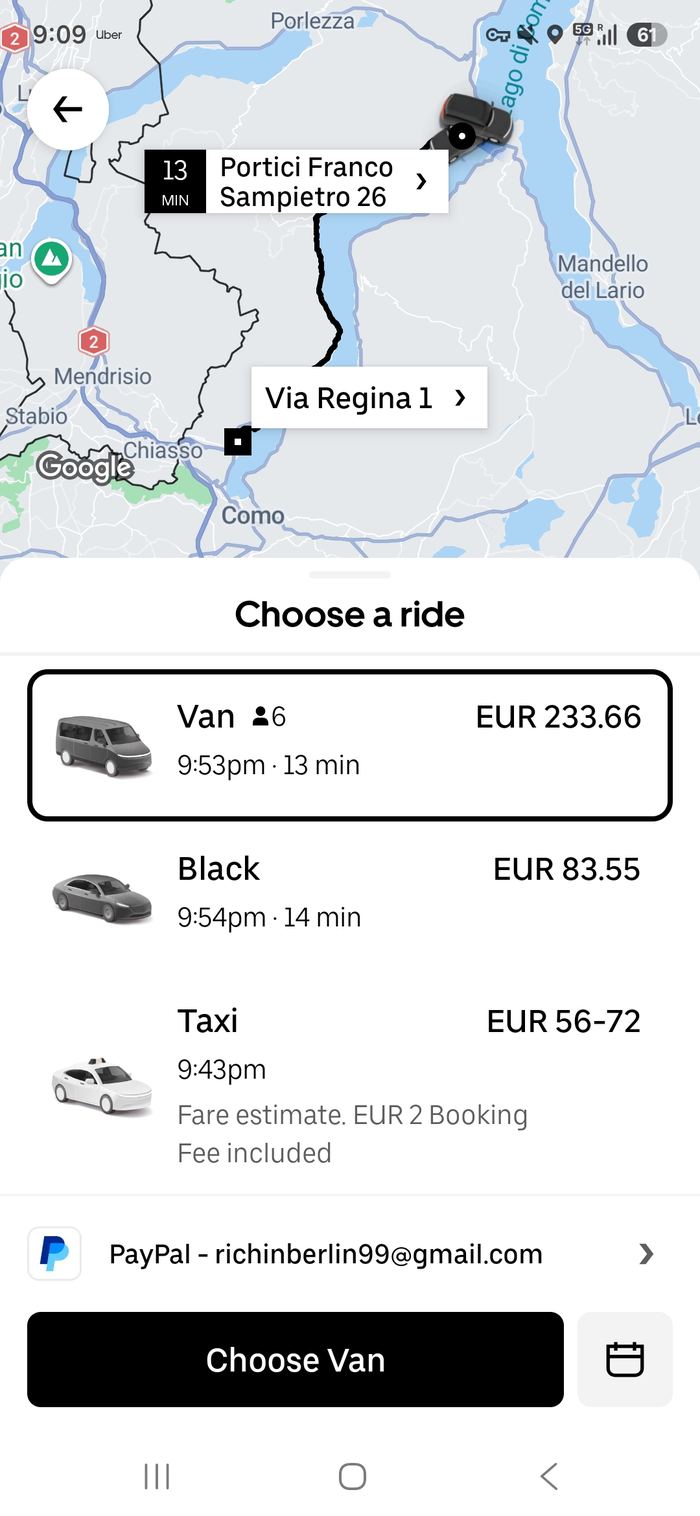
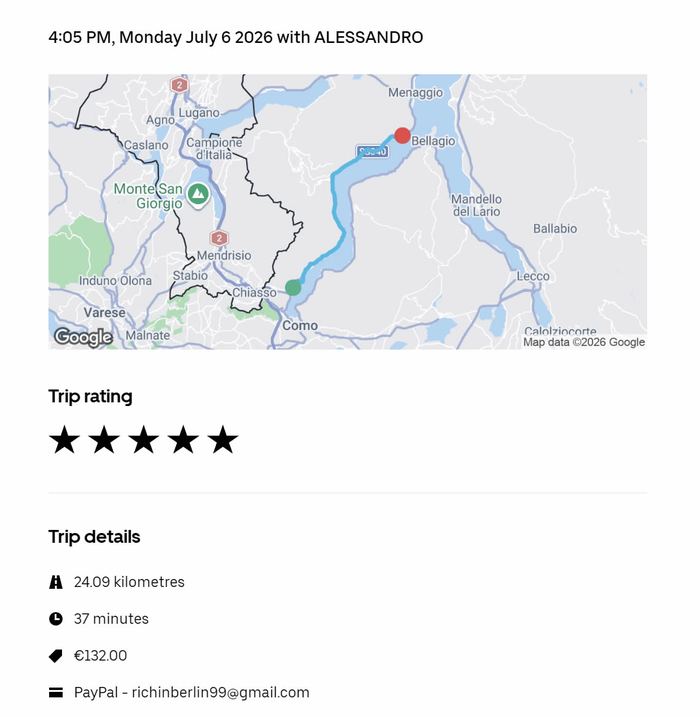
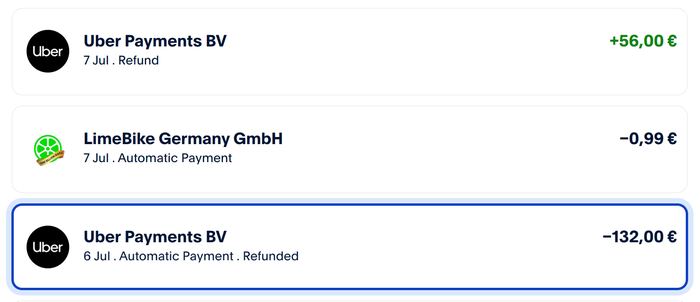
We booked an Uber Taxi from Como to Bellagio. The app quoted €56–72. The driver never turned on a meter we could see. At the end of the ride, we were charged €132 - and told, again and again, that a taximeter made it so.
Monday, 4:05pm. A car from Como to Bellagio, driven by Alessandro, 24.09 kilometres, 37 minutes. Google's own route data for that stretch of lakeside road shows nothing unusual - no closures, no diversions, no reason for the trip to have taken longer or gone further than planned. The ride itself was pleasant enough that we rated it five stars.
The problem was entirely the number that arrived afterwards.
Uber's own quote screen - screenshotted from the same road, the same evening - priced a comparable Taxi trip at €56–72, booking fee included. We also checked what local Como-area cab companies advertise on their own sites for a per-kilometre rate. Even using a rate 70 cents above the highest one we could find published anywhere locally, the ceiling for this trip lands around €78.77. That means the number below is already generous to Uber: the real fare, if a meter had actually run, was more likely lower than this, never higher.
Uber's flow asks you to rate the driver and the trip before the final fare is revealed. The ride was fine, so we gave five stars - genuinely, and irreversibly, before finding out what we'd actually been charged. That ordering isn't an accident; it protects the fare from an honest reaction to it.
Every reply came from a different named agent. Every reply, until the last one, repeated the same two lines almost verbatim: the taximeter sets the price by Italian law, and the driver starts it when the ride is accepted. Nobody would show the meter reading itself.
Charged €132 against a quoted maximum of €76. Flagged that no traffic or toll caused the gap.
Pointed out that a fixed "off-meter" rate quoted roadside by local drivers (€90–100) was already below what Uber charged - the opposite of what a scam-avoidance premium should look like.
24km, 37 minutes, standard tariff - laid out line by line, with the conclusion that no legitimate metered fare reaches €132. Asked directly for the meter calculation used.
Fare "adjusted" back down to €76 - the original quoted maximum - with no meter reading, no breakdown, and no acknowledgment of what had actually gone wrong.
Repeated requests for the actual meter calculation - required under EU consumer rules when a charged amount is disputed - went unanswered on the merits.
This ride no longer appears anywhere in our Uber trip history. Not marked disputed, not marked refunded, not archived, just gone, as if it never happened. We didn't delete it. Nobody told us it would disappear, or why.
Uber refused to refund the full amount and ran the same script for over a week. PayPal was a different story. Once we opened a dispute for the unreasonable charge, PayPal told us plainly that Uber could either agree to the refund itself, or PayPal would return the money to us regardless. Uber does not get the final word on a charge you've disputed through your payment provider. If you paid by PayPal or card, that dispute route is very likely your fastest and strongest option, faster than waiting on rotating support agents to repeat the same paragraph at you.
The upfront estimate (€56–72) was never close to what was charged. Uber's own terms call the estimate non-binding, which leaves no real ceiling on what a driver-reported fare can claim.
In this region, taxi drivers running Uber trips appear able to submit whatever final fare they choose. Uber accepted it without ever producing a meter reading, a rate table, or a breakdown - even when asked for one directly, repeatedly, over more than a week.
| Uber support said | What the evidence shows |
|---|---|
| "The final fare is legally determined by the official taximeter." | No meter was ever visible during the ride, and no meter reading was ever produced afterward, despite repeated requests. |
| "The estimate can't account for real-time factors like traffic or detours." | The trip took 37 minutes over 24.09km - an ordinary pace for that route, with nothing in the log suggesting delay. |
| "We are not able to share detailed information of the fare breakdown." | Under EU consumer protection rules, a trader disputing a charge is expected to be able to substantiate it - not withhold the calculation as "internal." |
| "We've adjusted your fare to €76." | €76 is exactly the original quoted maximum - a number reached without ever explaining why €132 was charged in the first place. |
Ask your hotel to book you a car with a fixed price, first. It's almost always cheaper than what Uber ends up charging, and the price is certain before you get in, not a "estimate" that can be doubled after the fact.
Treat Uber as a last resort, not a default. If a hotel car or a pre-agreed local driver isn't an option, only then consider Uber, and even so, avoid the Taxi option entirely.
If you do use Uber, skip the Taxi option around Como and Bellagio. It's a non-binding estimate standing in front of a fare nobody but the driver controls. Black or Van are upfront, fixed prices, agreed before the ride starts - our return trip in a Black Van, in a nicer car, cost less than the "Taxi" had.
If you've been overcharged, dispute the charge with PayPal or your card provider directly. You do not need Uber's agreement first; PayPal made clear they'd refund the unreasonable amount whether or not Uber signed off.
If a fare is disputed, ask in writing for the metered calculation before accepting any "goodwill adjustment." A number with no math behind it isn't a resolution.
Screenshot the quote screen before you request the ride, and screenshot your trip history too. Ours vanished entirely once the dispute was resolved.